Introduction
Small farmers play a vital role in global food production. Across many countries, including Malaysia, small-scale farms contribute significantly to local food supply, rural livelihoods and community development.
However, small farmers often face numerous challenges, including rising production costs, unpredictable weather, soil degradation, pest outbreaks and limited access to resources.
To remain productive and resilient, many farmers are adopting sustainable farming practices that improve efficiency while protecting natural resources.
Sustainable farming does not necessarily require expensive technology or large investments. In many cases, practical and affordable techniques can help farmers improve productivity, reduce costs and strengthen long-term resilience.
This article explores sustainable farming practices that are particularly relevant for small farmers seeking to build productive and environmentally responsible agricultural systems.
What Is Sustainable Farming?
Sustainable farming refers to agricultural practices that meet current production needs while preserving resources for future generations.
The goal is to balance:
- Environmental protection
- Economic viability
- Social well-being
Sustainable farming focuses on maintaining healthy ecosystems while ensuring farmers can continue producing food and earning livelihoods over the long term.
Why Sustainable Farming Matters For Small Farmers
Small farmers often operate with limited land, financial resources and technical support.
Sustainable practices can help them:
- Reduce production costs
- Improve soil fertility
- Increase resilience to climate change
- Improve crop productivity
- Reduce dependence on external inputs
These benefits contribute to greater long-term stability and profitability.
Practice 1: Composting
Composting is one of the simplest and most effective sustainable farming practices.
Organic materials such as:
- Food scraps
- Crop residues
- Dry leaves
- Grass clippings
- Animal manure
can be converted into nutrient-rich compost.
Benefits include:
- Improved soil fertility
- Better soil structure
- Increased water retention
- Reduced waste
Composting reduces reliance on synthetic fertilisers while enhancing soil health.
Practice 2: Crop Rotation
Growing the same crop repeatedly on the same land can lead to nutrient depletion and pest problems.
Crop rotation involves planting different crops in sequence over time.
Benefits include:
- Improved soil fertility
- Reduced pest pressure
- Better weed management
- Enhanced biodiversity
Crop rotation is particularly useful for maintaining healthy and productive farming systems.
Practice 3: Mulching
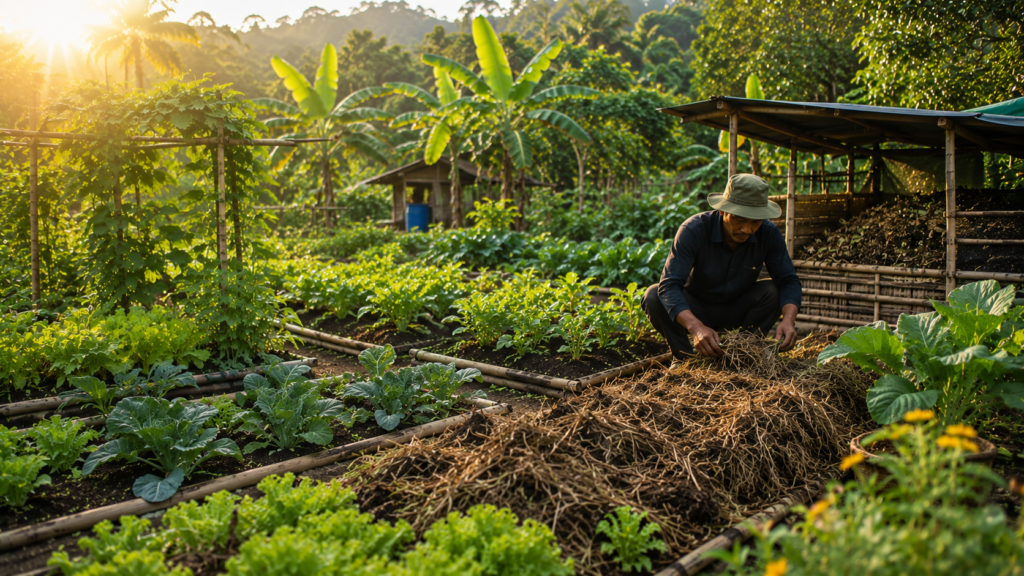
Mulching involves covering soil with organic materials such as:
- Straw
- Dry leaves
- Grass cuttings
- Compost
Mulching helps:
- Reduce moisture loss
- Suppress weeds
- Improve soil structure
- Protect soil from erosion
This simple technique can significantly improve water efficiency and soil health.
Practice 4: Integrated Pest Management
Pests can cause major crop losses, but excessive pesticide use can create environmental and health concerns.
Integrated Pest Management (IPM) combines multiple strategies to control pests responsibly.
Examples include:
- Monitoring pest populations
- Encouraging beneficial insects
- Using biological controls
- Practising crop rotation
IPM reduces chemical dependence while maintaining crop protection.
Practice 5: Water Conservation
Water availability is becoming increasingly important for agriculture.
Sustainable water management practices include:
- Rainwater harvesting
- Drip irrigation
- Mulching
- Soil moisture conservation
Efficient water use helps farmers remain productive during periods of drought or water scarcity.
Practice 6: Diversified Farming Systems
Diversification reduces risks associated with market fluctuations and environmental challenges.
Examples include:
- Growing multiple crops
- Integrating livestock
- Agroforestry systems
- Mixed farming approaches
Diversified farms often demonstrate greater resilience and stability.
Practice 7: Agroforestry
Agroforestry combines trees with agricultural production.
Benefits include:
- Improved biodiversity
- Enhanced soil protection
- Carbon sequestration
- Additional income sources
Trees can also provide shade, wind protection and habitat for beneficial organisms.
Practice 8: Soil Health Management
Healthy soil is essential for sustainable farming success.
Farmers can improve soil health through:
- Composting
- Organic matter additions
- Cover crops
- Reduced tillage
Healthy soils support stronger plant growth and improve resilience to environmental stress.
Climate Resilience Through Sustainable Farming
Climate change presents growing challenges for agriculture.
Sustainable farming practices help farmers adapt through:
- Improved soil water retention
- Greater biodiversity
- Reduced environmental degradation
- Increased system resilience
These benefits are particularly important for small farmers who may be more vulnerable to climate-related risks.
Sustainable Farming In Malaysia
Many Malaysian farmers are increasingly adopting sustainable approaches.
Examples include:
- Composting programmes
- Community agriculture initiatives
- Agroecology projects
- Natural farming methods
- Urban agriculture
Organisations such as MISA support these efforts through training, demonstrations and community engagement activities.
By sharing practical knowledge and hands-on learning experiences, these programmes help farmers transition toward more sustainable production systems.
Challenges To Adoption
Despite the benefits, small farmers may face challenges such as:
- Limited technical knowledge
- Initial transition periods
- Access to training
- Financial constraints
Addressing these challenges requires continued education, support networks and collaboration among stakeholders.
Conclusion
Sustainable farming practices provide practical solutions for small farmers seeking to improve productivity, reduce costs and protect natural resources.
Through techniques such as composting, crop rotation, water conservation and agroforestry, farmers can build resilient agricultural systems that support both livelihoods and environmental sustainability.
As agriculture continues to face new challenges, sustainable farming will play an increasingly important role in creating productive, resilient and food-secure communities.
